Rationales
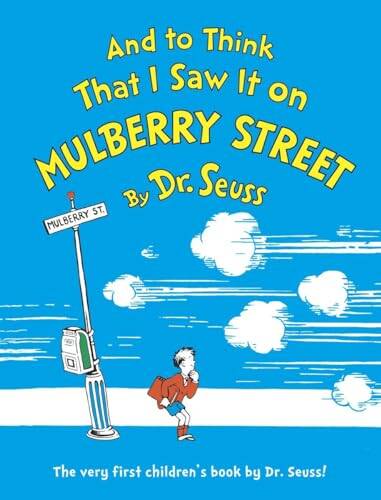
And to Think that I Heard it on Mulberry Street
Summary and Educational Significance
As Marco makes his way home from school his imagination turns a simple horse and wagon into an increasingly fantastical parade. The horse becomes a zebra then a reindeer followed by an elephant and finally two giraffes join in to help. The giraffes are needed because not only is the farmer now sitting atop the elephant in a grand throne, but the wagon has become so large that a whole brass band fits on it, and a trailer is attached to the back so an audience can sit and listen.
After Marco imagines this grand transformation of the simple horse and cart, he begins thinking of additional characters who have joined in. There is now a police escort, stands where the mayor sits and watches, an airplane dumping out confetti, and more! By the time Marco reaches home he has an amazing story to tell his father about what he saw while walking home, but Marco does not share. He simply replies, “Nothing […] But a plain horse and wagon on Mulberry Street,” (Dr. Seuss, 1937).
This book is a great example of how we can use our imaginations to turn something as mundane as a horse and cart into a fantastical adventure. Encouraging young children to embrace their imaginations and be creative is essential for future learning. Literature that catches a child’s interest and keeps them entertained leads to children who want to continue experiencing books and a desire to learn to read.
Alternative Works
Harold and the Purple Crayon by Crockett Johnson
Cloudy with a Chance of Meatballs by Judi Barrett
Oh, the Thinks you Can Think! by Dr. Seuss
Is Your Mama a Llama? by Deborah Guarino
How I Became a Pirate by Melinda Long
Purpose and Use
One of the best ways to teach a child to read is to develop a love of reading from a young age. Developing this love starts from the lap of a parent, caregiver, or teacher who engages the child in reading a favorite book. Using this book in the classroom during circle time is one of the most basic ways to incorporate it into learning. Once the book is read it can lead to discussions about what kinds of things the children see on their way to school. The teacher can encourage the child to start with something simple that they saw and develop it into a story from their imagination.
Potential Problems and How They Can be Handled

And to Think that I Saw it on Mulberry Street is the first of Dr. Seuss’s 60 plus children’s books and is one of six that Seuss Enterprises has decided to stop publishing due to racist imagery. The main example in this book is the depiction of an Asian character drawn with yellow skin and referred to as “Chinaman.” In later editions of the book the color was removed, and the character was referred to as “Chinese boy” then “Chinese man” instead. Despite these changes the decision to stop publishing this book was made.
In the best interest of cultural sensitivity, I would probably not use this book in my classroom. The children are only 2 years old and would not understand how the depiction of this character could be seen as racist even with the changes made. As for the decision to completely stop publishing the book altogether, I feel that this decision may be going too far. I believe that it is important to learn from the mistakes of the past and this is a great example of that. In an interview with Geisel’s nephew, Theodore Owens, he comments, "It was the first time he had changed one of his books. 'Chinaman' was acceptable in 1937, but by 1978 that was not the case," Owens said. "Art and humanity are always evolving,” (Kelley, 2017).
If I Ran the Zoo
Summary and Educational Significance
Gerald McGrew has no interest in the animals at the zoo, they’re too “boring” for him. “The lions and tigers and that kind of stuff they have up here now are not quite good enough. You see things like these in just any old zoo. They’re awfully old-fashioned. I want something new!” (Dr. Seuss, 1950). If he ran the zoo, Gerald would fill it with much more interesting animals. Animals from all around the world each more fantastical than the last.
If I Ran the Zoo follows Gerald as he imagines what a zoo he designed would look like. With the turn of each page, we go along with Gerald on an adventure around the world to find new animals that no one has ever seen before and each one is zanier than the last. Finally, we see what McGrew’s zoo would look like, filled with its new animals. Excited patrons stream in through the open gates. Then we turn to the last page where McGrew is seen back at a regular zoo, he considers the zoo he has imagined. “‘Yes…That’s what I’d do,’ said young Gerald McGrew. ‘I’d make a few changes If I ran the zoo,’” (Dr. Seuss, 1950).
One of the best things about Dr. Seuss books is how the characters in them are shown using their imaginations, which encourages children to do the same. There is a common term in business to “think outside the box” motivate young children to think this way from the start means that it will come naturally to them when they are adults. It is much harder to think of something new when you have always been taught to do it the same as everybody else.

Alternative Works
Go, Dog. Go! by P.D. Eastman
Put Me in the Zoo by Robert Lopshire
A Fish Out of Water by Helen Marion Palmer
Library Lion by Michelle Knudsen
The Gruffalo by Julia Donaldson
Purpose and Use
This book would be a great starting point for encouraging children to use their imaginations by creating their own creatures. Reading the book and then having a classroom discussion on what kinds of creatures they would like to see in the zoo during circle-time is a start. Then, after you get them thinking about what they would like to see in the zoo you can recreate it through drawing, painting, or sculpting. There are so many art activities that could be done based on If I Ran the Zoo. Letting the child take the reigns and having them create their own designs will lead to confidence in their own abilities in the future.
Potential Problems and How They Can be Handled

“This is the first book that we really see all of the qualities of a true Seussian children’s book. It is a bestiary book created by a child’s imagination full of creatures and odd machines with Seussian names and characteristics,” (St. Rebor, n.d.). At first glance the book seems to be filled with magical, made-up creatures, but there is a definite reference to real cultures throughout the book with not-so-subtle racist undertones. The line “I'll hunt in the mountains of Zomba-ma-Tant / With helpers who all wear their eyes at a slant,” (Dr. Seuss, 1950) accompanied by an illustration of stereotypical Asian men is one of several. The stereotypes continue with the illustrations of a Russian and Arab looking characters. In my opinion the most offensive illustration is that of two characters representing Africans. They are drawn with visibly ape-like features and are shown wearing only grass skirts.
While I do really like the idea of this book and love the imaginativeness of it, I do not see myself being able to use it in the classroom as is with young children. The racist undertones are too strong, and it would be impossible to show children these images without a deep conversation about racism and two-year-olds are definitely too young to understand. This may be the only one of the six books that have been taken out of publication that I agree with. While the others seem as though slight alterations could fix their problems If I Ran the Zoo seems too full of racist images to successfully edit it without completely changing the book.
The Cat's Quizzer
Summary and Educational Significance
In The Cat’s Quizzer we see the return of one of Seuss’s most famous characters, The Cat in the Hat. The book begins with The Cat in the Hat introducing the readers to Ziggy and Zizzy Zozzfozzel asking them if they “are smarter than a Zozzfozzel.” They are then lead through “a mixture of picture puzzles, logic tricks, and silly questions, The Cat's Quizzer will keep readers fascinated with a wide array of facts and fun!” (Google Books, n.d.). It includes such questions as “Do fish sleep with one eye open?” and “What do you call one eyed eye-glasses?”
One of the pages asks the reader to look hard at the picture then turn the page. On the next page they are asked to recall what they saw on the previous page. This test could have been inspired by Geisel’s own struggle at the time. In 1976 when this book was in development Geisel was experiencing sight loss due to cataracts and glaucoma. “Despite this arduous situation […] Ted never stopped working. What he did do was turn from his “big books” to creating shorter, less complicated Beginner Books,” (The Art of Dr. Seuss Collection, 2026).
These kinds of quiz books were always fun for me as a child. Combining the silly rhymes, fantastical creatures, and bright illustrations of Dr. Seuss with his wacky questions makes The Cat’s Quizzer one of the most fun quiz books I’ve come across. Asking children silly questions and coming up with silly answers is a great way to engage with children while reading.

Alternative Works
The Ultimate Book of Random Fun Facts by Bill O'Neill
Wrong Answers Only! by Yellow Carrot Publishing
Inside Your Outside! All About the Human Body by Tish Rabe and Aristides
The Cat in the Hat Beginner Book Dictionary by P.D. Eastman
I Can Read with my Eyes Shut! by Dr. Seuss
Purpose and Use
Having fun while reading is essential to learning how to read. Teaching a child something new that they are not interested in means that it will take longer and be harder for the child to learn. When they find something fun, they will be more willing to engage in the activity. Reading The Cat’s Quizzer with children is an exciting way to get them interested in reading on their own. The silly questions and challenges in the book are also great ways to encourage children to ask questions and continually look for answers. They can start with the questions in the book and this will hopefully lead them to more questions that will require more and different books to answer them.
Potential Problems and How They Can be Handled

Reading through The Cat’s Quizzer the book is filled with silliness. The questions are purposefully written to make children laugh. Despite the general lightheartedness of the book there are a few instances that can be seen as offensive. The most obvious one is the question, “How old do you have to be to be a Japanese?” The use of the term “a Japanese” is an offensive way to refer to Japanese people. Another reference to Japanese people in an offensive way is this question, “Do the Japanese eat with pogo sticks or joss sticks?” The use of “the Japanese” is offensive as well as the question itself seems a little odd. The answer is of course neither, as a pogo stick is a toy and joss sticks are incense, the correct answer is chopsticks.
To use this book in the classroom I would simply not ask those questions that are offensive. The children in my class cannot read so I feal that it would be easy to pass over these sections with little notice from the children. The actual illustration of the question containing the term “a Japanese” does have a very yellow background with the person’s skin matching the color. This is not a great depiction, but a simple fix would be to make the background along with the skin color white. As this book will no longer be published that is not something that will be done.